General discussion about 3D DCC and other topics
-
Bullit
- Moderator
- Posts: 2621
- Joined: 24 May 2012, 07:44
Post
by Bullit » 30 Aug 2014, 17:20
ICE made me more aware and more interested in Maths. One of way i go is to read Math History. People, how theories born etc. Since i don't like theory for theory sake.
The question:
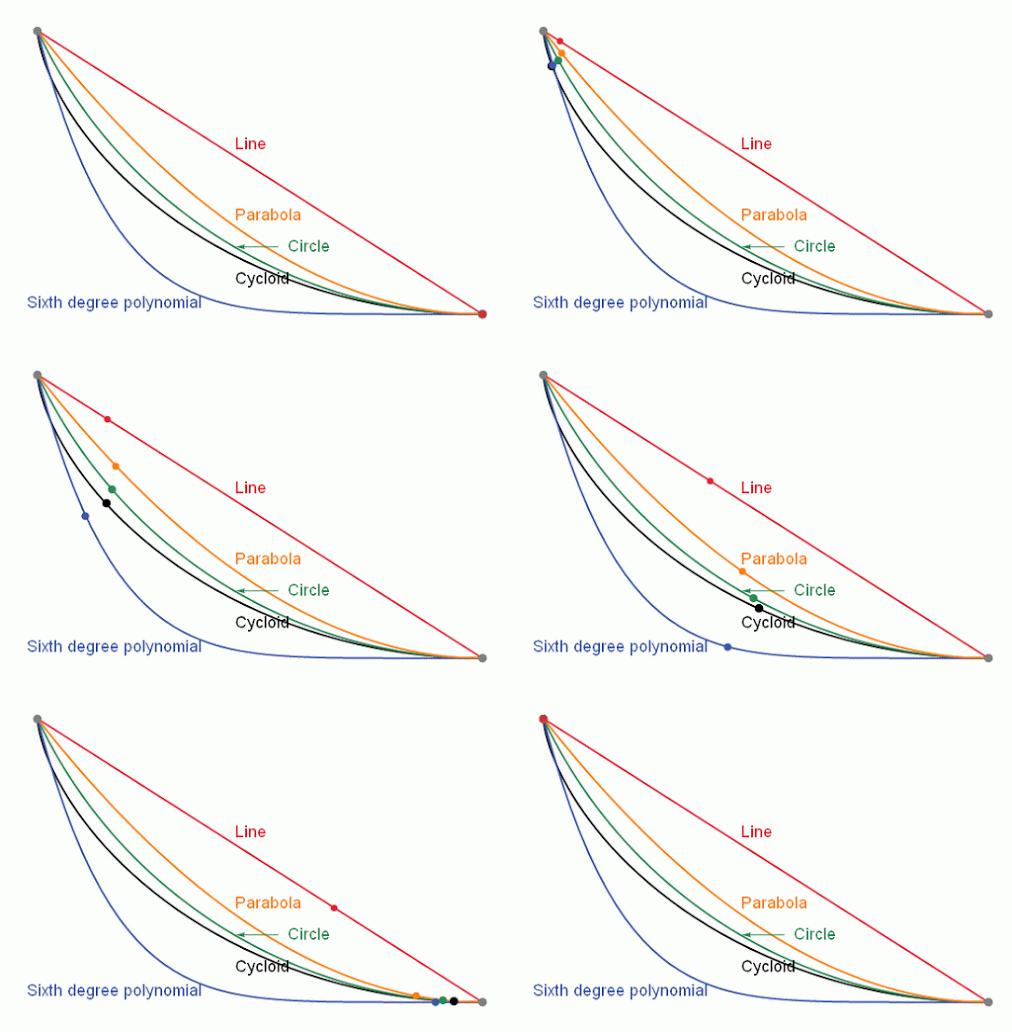
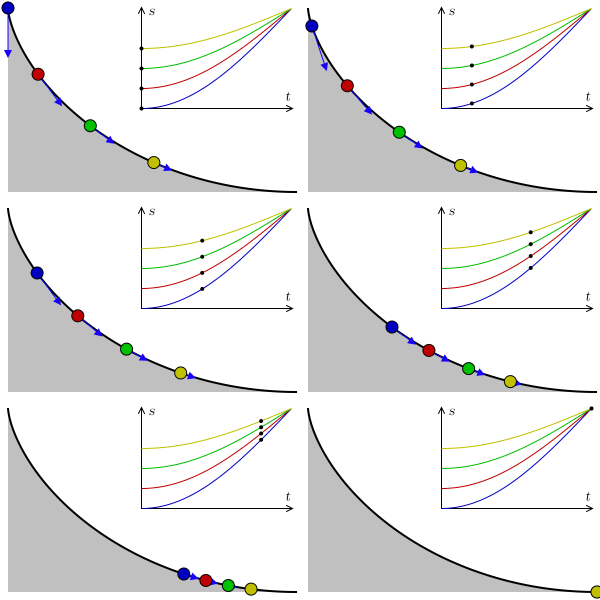
If a ball is to roll down a ramp which connects two points, what must be the shape of the ramp’s curve be, such that the descent time is a minimum?
So what is the answer? I know but i was empirically wrong albeit not by much.
It also would be interesting to test if 3D applications rigid body dynamics systems respect the physical result.
-
rray
- Moderator
- Posts: 1810
- Joined: 26 Sep 2009, 13:51
- Location: Bonn, Germany
Post
by rray » 31 Aug 2014, 01:36
No idea - I believe this will either have a very simple solution or a very complex one ;)
A great site where you're nearly guaranteed to get an answer for these kinds of questions is:
http://math.stackexchange.com
-rr
-
angus_davidson
- Posts: 583
- Joined: 20 Dec 2012, 04:13
- Skype: ithacapellin
Post
by angus_davidson » 31 Aug 2014, 10:03
Bullit wrote:ICE made me more aware and more interested in Maths. One of way i go is to read Math History. People, how theories born etc. Since i don't like theory for theory sake.
The question:
If a ball is to roll down a ramp which connects two points, what must be the shape of the ramp’s curve be, such that the descent time is a minimum?
So what is the answer? I know but i was empirically wrong albeit not by much.
It also would be interesting to test if 3D applications rigid body dynamics systems respect the physical result.
Just off hand I would have thought the fastest decent would involve getting as close to 90 degree straight down as you can, so that your still technically a ramp and not a drop ;) Note this is different from a brachistochrone curve as you specified decent (ie movement in one axis)and not the total move from point a to b.
And thats enough thinking for a sunday ;)
--
Technomancer at Digital Arts
Wits University
-
csaez
- Posts: 253
- Joined: 09 Jul 2012, 13:31
- Skype: csaezmargotta
- Location: Sydney, Australia
Post
by csaez » 01 Sep 2014, 05:49
What an interesting reading! thanks for sharing

-
ChrB
- Posts: 55
- Joined: 10 Jun 2009, 11:26
Post
by ChrB » 02 Sep 2014, 10:43
I presume these calculations take place in an ideal space, e.g. there are no friction or wind resistance. Taking these factors into account, I would presume (sorry no time for calculations right now) that the straight curve would likely be the fastest path?
Arnold for the masses!
-
angus_davidson
- Posts: 583
- Joined: 20 Dec 2012, 04:13
- Skype: ithacapellin
Post
by angus_davidson » 02 Sep 2014, 10:45
ChrB wrote:I presume these calculations take place in an ideal space, e.g. there are no friction or wind resistance. Taking these factors into account, I would presume (sorry no time for calculations right now) that the straight curve would likely be the fastest path?
As far as I am aware there is friction, other wise the ball would not be considered rolling, but rather sliding.
--
Technomancer at Digital Arts
Wits University
-
Mathaeus
- Posts: 1778
- Joined: 08 Jun 2009, 19:11
- Location: Zagreb, Croatia
Post
by Mathaeus » 02 Sep 2014, 11:11
ChrB wrote:I presume these calculations take place in an ideal space, e.g. there are no friction or wind resistance. Taking these factors into account, I would presume (sorry no time for calculations right now) that the straight curve would likely be the fastest path?
I think it became much more accelerated along first half of cycloid, in another half, all needed is a curve type that doesn't decelerate it too much. By the way, I have to admit I've found a spoiler, just by pasting the question into Google search, so don't even know what's my personal presumption, unfortunately.