






































Hi,
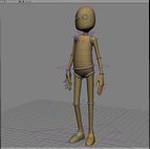
In the new 3Dworld mag there was an article about topology in game design. Has anyone tried the to export a low res Zbrush mes and then adding on specific areas edge loops.
The way the've done it -> see attachment - > It looks like you don't even need a muscle system anymore. Just some clever placed bones will do the trick. I've always done retopo
after building a high res mesh. But these guys simply export at a low level a Zbrush mesh and add edge loops instead of doing a whole new low res mesh. Does anyone of you guys have
experience with this approach?
Has anyone ever used this piece of software
http://www.atangeo.com/
Moderator edit: please use the URL tags - HB
A topology question
-
curly
- Posts: 77
- Joined: 06 Oct 2010, 06:43
A topology question
You do not have the required permissions to view the files attached to this post.
-
Manticor
- Posts: 160
- Joined: 09 Jun 2011, 20:41
Re: A topology question
Yes this is a quicker way of working and one that I use.
The process I use it to export the low mesh and import that in as a base mesh for retopo (.I personally use 3d coat for the bulk of retopo and finish the fiddly areas in softimage then back into 3D coat for Uving ...I only have XSI 7.01 so dont have the unfold uvs op ).I then analyze the form of the mesh in silhouette and create geometry in crucial areas ..i.e clothing creases .Then I delete polygons in the same areas on the base mesh and stitch the newly created crease parts.Ive found that this is a quicker way to get the job done.Also creating edge loops near the area general areas on the base mesh and nudging the loops into the creases also speeds things up rather than creating from scratch and stiching them up.I highly recommend 3D coat for the bulk of the work and finishing problem areas like tight corners in xsi.This workflow is one I use for creating low poly game models ,Id use a different method for carrying on high poly sculpting.
Ive had some ideas on a better retopo system using neigbouring angle/cavity analysis with ice ,but Im still a newbie when it comes to ice so not an option at the moment.
Hope this helps
M
The process I use it to export the low mesh and import that in as a base mesh for retopo (.I personally use 3d coat for the bulk of retopo and finish the fiddly areas in softimage then back into 3D coat for Uving ...I only have XSI 7.01 so dont have the unfold uvs op ).I then analyze the form of the mesh in silhouette and create geometry in crucial areas ..i.e clothing creases .Then I delete polygons in the same areas on the base mesh and stitch the newly created crease parts.Ive found that this is a quicker way to get the job done.Also creating edge loops near the area general areas on the base mesh and nudging the loops into the creases also speeds things up rather than creating from scratch and stiching them up.I highly recommend 3D coat for the bulk of the work and finishing problem areas like tight corners in xsi.This workflow is one I use for creating low poly game models ,Id use a different method for carrying on high poly sculpting.
Ive had some ideas on a better retopo system using neigbouring angle/cavity analysis with ice ,but Im still a newbie when it comes to ice so not an option at the moment.
Hope this helps
M
-
Bellsey
- Posts: 688
- Joined: 19 Apr 2010, 09:50
- Location: London, UnitedKingdom
Re: A topology question
there was a booth presentation from Naughty Dog at GDC or Siggraph, I can't recall, which showed the workflow that I use.
Start in the main 3D app and build a base mesh up, fleshing it out so to speak, then transfer to Mudbox to really build it up and develop it more. Then transfer back to the 3D app a mid-subdivided level of the mesh and use that as a guide to refine and retopo the original base mesh so that it matches the high detail version in Mudbox.
Yes there is 3D-coat and Topogun for retopologising meshes, and they are very good. But if you're smart you can actually use the existing tools in all the main 3D apps. Max's graphite tools, in particular are very good, and for retopo can do what 3D-coat actually does.
Start in the main 3D app and build a base mesh up, fleshing it out so to speak, then transfer to Mudbox to really build it up and develop it more. Then transfer back to the 3D app a mid-subdivided level of the mesh and use that as a guide to refine and retopo the original base mesh so that it matches the high detail version in Mudbox.
Yes there is 3D-coat and Topogun for retopologising meshes, and they are very good. But if you're smart you can actually use the existing tools in all the main 3D apps. Max's graphite tools, in particular are very good, and for retopo can do what 3D-coat actually does.
-
curly
- Posts: 77
- Joined: 06 Oct 2010, 06:43
Re: A topology question
A question for the guy from Autodesk. Is there any chance you guys implement a Mesmixer feature in Autodesk Mudbox. This would enable modelers to build a seperate head mesh
and then attach it to the body in Mudbox with Mudbox doing all the connecting of meshes.
and then attach it to the body in Mudbox with Mudbox doing all the connecting of meshes.
-
Bellsey
- Posts: 688
- Joined: 19 Apr 2010, 09:50
- Location: London, UnitedKingdom
Re: A topology question
I can't really talk for the dev team about what could be done in the future, and we're not allowed to talk about product roadmaps anyway.
Contrary to what many might think, we don't simply make up features to then add into the software, if there's enough validation from customers about a particular workflow or feature, then it doesn't get ignored.
Contrary to what many might think, we don't simply make up features to then add into the software, if there's enough validation from customers about a particular workflow or feature, then it doesn't get ignored.
-
muybridge
- Posts: 1
- Joined: 19 Aug 2010, 22:08
Re: A topology question
Hi Guys.
Sorry for coming up with a new question inside this thread. But while reading your posts and just knowing basics about digital sculpting I`m wondering what´s this retopo all about?
I thought you model your base mesh in a 3d app, then sculpt on top of it in a sculpting app and export the outcome as a normal map that is used for displacement on your base mesh.
So why would you retopo anything?
Thanks for your help. I´m still learning and trying to clarify some things to myself.
Sorry for coming up with a new question inside this thread. But while reading your posts and just knowing basics about digital sculpting I`m wondering what´s this retopo all about?
I thought you model your base mesh in a 3d app, then sculpt on top of it in a sculpting app and export the outcome as a normal map that is used for displacement on your base mesh.
So why would you retopo anything?
Thanks for your help. I´m still learning and trying to clarify some things to myself.
-
rray

- Moderator
- Posts: 1810
- Joined: 26 Sep 2009, 13:51
- Location: Bonn, Germany
Re: A topology question
to muybridge - it's when the model is modified to an extent that the original base can't be used for that anymore. Happens often when sculpting apps are used for designing, as opposed to refining a model (for example when starting from a sphere etc.)
softimage resources section updated Sep 26th 2026
-
Bellsey
- Posts: 688
- Joined: 19 Apr 2010, 09:50
- Location: London, UnitedKingdom
Re: A topology question
Topology is essentially the layout of verts, edges and edge loops that create the polygon 'flow' of your model. So if you use a base mesh to sculpt up to a higher level,
you sometimes may have to retopologize it near the end of your workflow to create the correct polygon flow. Topology also affects UV mapping and how well you can extract various maps, like normals, Ambient Occlusion and displacements.
Topology is especially important for models in computer games, as these models must make the best use of every single polygon due to budget constraints. Game artists will use packages like Mudbox, zBrush, to sculpt and add in lots of detail, but in order to do this the mesh detail will sometimes increase to several million polys. These higher detail models are just not practical for ingame usage and so the artist must produce a lower spec version to meet the games requirements. This often means retopologising the original base mesh so it syncs up with the higher detail version, or even doing the same to a lower version of the high res model.
you sometimes may have to retopologize it near the end of your workflow to create the correct polygon flow. Topology also affects UV mapping and how well you can extract various maps, like normals, Ambient Occlusion and displacements.
Topology is especially important for models in computer games, as these models must make the best use of every single polygon due to budget constraints. Game artists will use packages like Mudbox, zBrush, to sculpt and add in lots of detail, but in order to do this the mesh detail will sometimes increase to several million polys. These higher detail models are just not practical for ingame usage and so the artist must produce a lower spec version to meet the games requirements. This often means retopologising the original base mesh so it syncs up with the higher detail version, or even doing the same to a lower version of the high res model.